Memories attributed to composers and the stories behind pieces, with their sources. Each story shows how reliable its source is; read each one on its own page and listen to the piece.
Sheet music archive
Classical Turkish music works in real staff notation with AEÜ accidentals. Read the score, hear it with kanun sound, adjust the tempo.
Century
Works
No matching works found.
The archive only holds classical and sacred works whose composer and lyricist died more than 70 years ago; folk songs (türkü) and recent composers are not included for copyright reasons.
The level is estimated automatically from the score: range, notes per second, tempo, short and dotted values, the length and asymmetry (aksak) of the usul, the variety of perdes and the length of the piece are scored together. It is a guide, not a substitute for a teacher's judgement.
The archive only includes works by composers whose copyright has expired.
The level is estimated automatically from the score (range, speed, rhythm, usul, variety of perdes, length).
%75%100%125
♪♩♪Loading score…
Beat sound
Learn this piece
Work through the piece step by step: listen, slow down, get to know its usul and makam, follow the score and play it on a virtual instrument.
About this workThe story of the piece
The story linked to this piece, as told in the sources. The reliability of the source is shown above it; the sources are listed at the end of the page.
Lyrics
Meaning
Recordings
Similar works
Sources
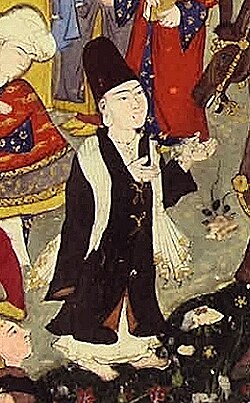
Representative depiction
Rumi
Founder of the Mevlevi tradition · Born: 1207 · Died: 1273 Hijri calendar: 603/04 – 671/72
Founder of the Mevlevi order; sema, the ney and the Mevlevi ayin laid the foundation of a musical tradition that lasted for centuries.
Place in music: Sema tradition, source of the lyrics of the Mevlevi âyin
Life
Rumi was born in Balkh in Khorasan and died in Konya. He came to Anatolia with his father, the scholar and Sufi Baha al-Din Walad. His meeting with Shams-i Tabrizi in 1244 was a turning point in his life and transformed him from a madrasa teacher into an ecstatic Sufi poet. The Masnavi and the Divan-i Kabir are his principal works. He brought sema and music into devotional life; the ney and the rebab came to the fore in his circle. The Mevlevi order received its organized form through his son Sultan Walad, and the lyrics of the Mevlevi âyin are largely taken from his poems.[1, 2]
Contributions to music theory
Memories
Memories attributed to him and told in the sources. The reliability of the source is shown above each one; the sources are listed at the end of the page.
In the score archive
Our score archive has no piece related to Rumi yet. If you have a public-domain score, you can send it to us.
The level is estimated automatically from the score: range, notes per second, tempo, short and dotted values, the length and asymmetry (aksak) of the usul, the variety of perdes and the length of the piece are scored together. It is a guide, not a substitute for a teacher's judgement.
Collections
Usuls without works in the archive
No works in these usuls are in the score archive yet; you can hear their düm-tek patterns in the usul metronome.