Olmaz İlaç Sîne-i Sad-Pâreme
Composer: Hacı Arif Bey (1831–1885) · Lyricist: Namık Kemal
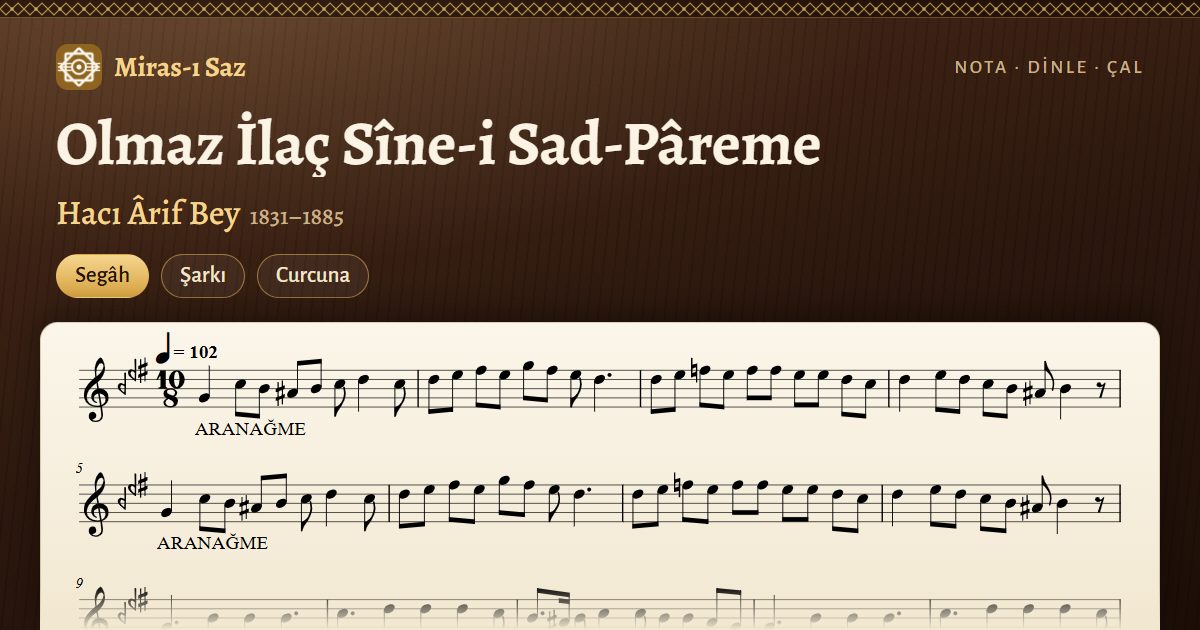
Olmaz İlaç Sîne-i Sad-Pâreme is a composition by Hacı Arif Bey: makam Segâh, form Şarkı, usul Curcuna.
The level is estimated automatically from the score (range, speed, rhythm, usul, variety of perdes, length).
Learn this piece
Work through the piece step by step: listen, slow down, get to know its usul and makam, follow the score and play it on a virtual instrument.
About this work
The story of the piece
The story linked to this piece, as told in the sources. The reliability of the source is shown above it; the sources are listed at the end of the page.
After Zülfinigâr
After Çeşmidilber, Hacı Ârif Bey returned to his post as music teacher at the palace; as it is told, this time he married a harem woman named Zülfinigâr and again left the palace. His wife died of tuberculosis a year later. The composer expressed this grief in this segâh song and in a hicaz song beginning “Kamer-çehre perî-rû tende cânım”. The first line of the song:
Olmaz ilâç sîne-i sad-pâreme
Lyrics
Olmaz ilaç sîne isadpâreme Çare bulunmaz bilirim yareme Baksa tabîbân-ı cihan çareme Kastediyor tîr-i müjen cânıma Gözleri en son girecek kanıma Şerhedemem halimi cânânıma
Meaning
Recordings
- TarkanOlmaz İlaç Sine-i Sad Pareme · Ahde Vefa · 2016 · 3:23Deezer (artist)YouTube (artist)
- Safiye AylaOlmaz İlac Sine-i Sad Pareme · Geçmişten Günümüze Türk Müziği Aşk ve Hüzün · 2000 · 3:19Vocals: Safiye AylaDeezer (artist)
- Search on YouTube
- Fatih ErkoçOlmaz İlaç · Babamdan Miras · 2012 · 3:24Deezer (artist)
- Önder FocanCan't Cure (Olmaz İlaç Sine-i Sad Pareme) · Beneath the Stars / Yıldızların Altında · 1997 · 8:14guitar: Önder Focanmembranophone: Bill StewartHammond organ: Sam YahelSearch on YouTube
- Ergin KızılayOlmaz İlaç Sine-i Sad-Pâreme · Türk Müziğinde Ud İle Anılar · 1993 · 3:20Oud: Ergin KızılayDeezer (artist)Apple Music (artist)
- Deezer (artist)
- Deezer (artist)
- Koray SafkanOlmaz İlaç Sine-i Sad Pareme · TRT İstanbul Radyosu - 24.02.1992 · 1992 · 3:06Oud: Mehmet BitmezViolin: Ayhan ÇakırClarinet: Nuri GünViolin: Aslan Hepgürpercussion: Güngör HoşsesClassical kemençe: Fikret KarakayaViolin: Aydın OranNey: Ahmet ŞahinKanun: Bertan ÜsküdarlıVocals: Koray SafkanSearch on YouTube
- İlyas TetikOlmaz İlaç Sine-i Sad Pareme · Türk Müziğinde Keman İle Ölmeyen Şarkılar 1 · 1993 · 3:27Violin: İlyas TetikSearch on YouTube
- Recep BirgitOlmaz İlaç Sine-i Sad Pareme · Türk Bestekarları Serisi - Hacı Arif Bey · 2001 · 3:17Tanbur: Murat AydemirClassical kemençe: Ahmet Kadri RizeliKanun: Safinaz RizeliNey: Volkan YılmazVocals: Recep BirgitSearch on YouTube
- Aziz Türk Sanat Müziği GrubuOlmaz İlaç Sine-i · Canlı Fasıl 7 - Segah · 2004 · 3:04percussion: Seyhun ÇelikOud: Yıldıran GüzClarinet: Şükrü KabacıKanun: Göksel KartalViolin: Ömer ÖcalVocals: Atakan AkdaşVocals: Neveser GerginokVocals: Aslı GünVocals: Arzu KopuzVocals: Müzeyyen PınarVocals: Burhan TuzerSearch on YouTube
Hacı Arif Bey: other works
Similar works
Sources
Notation and playback data: Miras-ı Saz (AEÜ accidentals, comma precision) · adapted from (CC BY-NC-SA 4.0, non-commercial use): SymbTr · Work data: MusicBrainz · License CC BY-NC-SA 4.0: share with attribution, for non-commercial use and under the same license.